Description
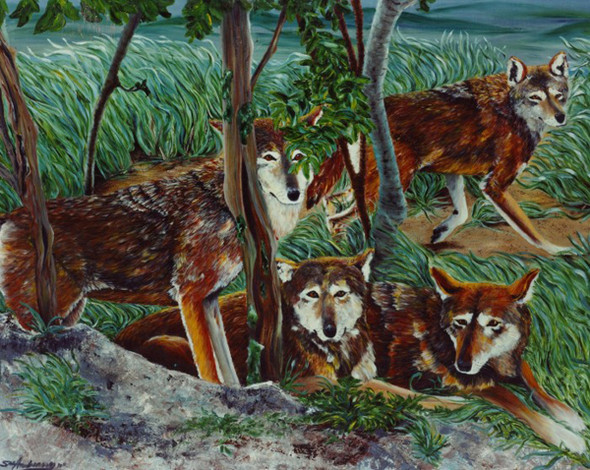
Depicts endangered plains and wood bison, highlighting their historical decline due to hunting and habitat loss. The painting references the forced relocation of the Cherokee people and the interconnectedness of species and landscapes. Current conservation efforts have led to a modest recovery of bison populations.
Several species that are truly endangered. This includes the plains and fauna that all species need to survive. The Cherokee people are originally from the southeastern United States but were forcibly relocated to Indian Territory in the 1830s, known as the Trail of Tears.
Two subspecies or ecotypes have been described as bison, smaller and with a more rounded hump; and the wood bison the larger of the two and having a taller, square hump. Furthermore, the plains bison has been suggested to consist of a northern plain and a southern plains bison subspecies, bringing the total to three. However, this is not supported. The wood bison is one of the largest wild species of extant in the world, surpassed only by the Asian . Among land animals in North America, the bison is the heaviest and the longest, and the second tallest after the moose.
Once roaming in vast herds, the species nearly became extinct by a combination of commercial hunting and slaughter in the 19th century and introduction of bovine diseases from domestic cattle. With an estimated population of 60 million in the late 18th century, the species was culled down to just 541 animals by 1889 as part of the subjugation of the Native Americans, because the American bison was a major resource for their traditional way of life (food source, hides for clothing and shelter, and horns and bones for tools). Recovery efforts expanded in the mid-20th century, with a resurgence to 31,000 wild bison as of March 2019. For many years, the population was primarily found in a few national parks and reserves. Through multiple reintroductions, the species now freely roams wild in several regions in the United States, Canada and Mexico,
The sun is setting on the landscape and the species. They are all connected to one another.
Additional Information
Artists: |
Susan Andreasen |
Orientation: |
Portrait |
Rights: |
Original |
Seller: |
ANDREASEN ASSOCIATES INC |