
How to Light Large Paintings Without Overpowering Your Room
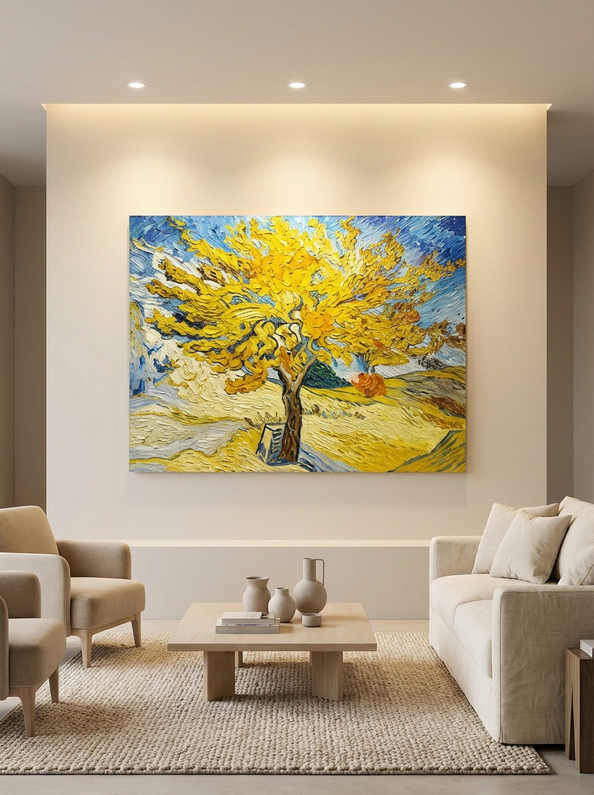
You’ve found the perfect large-scale artwork. It’s bold, it’s beautiful, and it demands attention. But once you hang it on the wall, something feels off. Maybe it disappears into the shadows at night, or perhaps the nearby floor lamp creates a distracting glare across the canvas. Lighting large art is a delicate balancing act. Too little light, and the piece loses its impact; too much, and your living room starts to feel like a sterile museum gallery.
The goal is to enhance your art, not let the lighting fixture steal the show. Proper illumination should feel like magic—you see the art, not the bulb. This guide will walk you through the practical steps of lighting oversized paintings so they integrate seamlessly with your home’s ambiance.
Why Lighting Large Art is Different
Large paintings present unique challenges compared to smaller framed photos or prints. A small picture light might work for a family portrait, but a 6-foot canvas requires a broader spread of light to avoid "hot spots"—intense pools of light in the center that leave the edges in darkness.
Furthermore, large art often serves as the focal point of a room. If you blast it with high-intensity spotlights, you risk overpowering the rest of your decor and making the room feel uncomfortable. The key is subtlety and spread.
Choosing the Right Type of Lighting
The fixture you choose depends heavily on your ceiling height, the style of the room, and the texture of the artwork. Here are the three best options for large-scale pieces.
1. Ceiling-Mounted Accent Lights (Track or Recessed)
For most large artworks, ceiling-mounted lights are the superior choice. They allow you to direct light from a distance, ensuring even coverage across the entire canvas.
- Recessed Adjustable Lights: These are hidden in the ceiling and can be angled toward the wall. They offer the cleanest look, keeping the ceiling uncluttered.
- Track Lighting: If you cannot cut into your ceiling, track lighting is a flexible alternative. It allows you to position multiple heads to hit different parts of a large painting, ensuring no corner is left in the dark.
Pro Tip: Use a "wall washer" trim or lens. Unlike a spotlight that creates a concentrated beam, a wall washer spreads light widely and evenly, which is essential for big canvases.
2. Picture Lights
Picture lights are mounted directly above the artwork and remain a popular choice for traditional and transitional interiors. However, scale matters.
A small picture light on a large painting will only illuminate the top portion of the artwork. For proper coverage, the fixture should be at least half the width of the frame.
Modern LED picture lights, such as wide-format designs from Cocoweb, solve many of the limitations of older picture lights. High-quality LED optics provide even illumination across the canvas while remaining cool, energy-efficient, and safe for artwork. When properly sized, picture lights for large paintings can create a refined, gallery-style effect without overwhelming the room.

3. Wall Washers
Wall washers are fixtures designed specifically to bathe an entire wall in soft, even light. These can be floor-mounted (shining up) or ceiling-mounted (shining down). This is often the best way to light a massive piece of art without creating harsh shadows or glare, as it treats the wall itself as a glowing surface.

Getting the Color Temperature Right
Have you ever seen a painting that looked vibrant in the gallery but dull in your home? The culprit is likely Color Rendering Index (CRI) and color temperature.
High CRI is Non-Negotiable
For art, you need a light source with a CRI of 90 or higher (100 is natural sunlight). A low CRI light makes colors look muddy or flat. A high CRI bulb ensures the reds pop and the blues stay true.
Warm vs. Cool Light
- 2700K (Warm White): Best for residential settings. It matches the cozy vibe of most living rooms and bedrooms. It enhances earth tones, reds, and yellows in oil paintings.
- 3000K (Soft White): A slightly crisper white that works well for modern art or spaces with cooler color palettes.
- 4000K+ (Daylight): Generally too harsh and blue for a home environment.
Stick to 2700K or 3000K to keep the room feeling welcoming while still highlighting the art.
Positioning to Avoid Glare and Shadows
The biggest enemy of art lighting is glare, especially on oil paintings with texture or pieces protected by glass. The angle of the light determines whether you see the painting or just a reflection of the bulb.
The 30-Degree Rule
A widely accepted standard in lighting design is the 30-degree angle.
- Imagine a line from the center of the artwork to the ceiling.
- Place your light fixture so the beam hits the center of the art at roughly a 30-degree angle.
- Too steep (close to the wall): You create long, dramatic shadows from the frame or brushstrokes (raking light).
- Too shallow (far from the wall): You cause direct glare reflections in the viewer's eyes.
For a large painting, you may need to adjust this slightly. If the piece is very tall, you might need two light sources aimed at overlapping angles to cover both the top and bottom without distortion.
Integrating Lighting with Room Decor
Lighting shouldn't be an afterthought; it’s part of the design. The hardware itself needs to match your room's aesthetic.
- Minimalist Rooms: Go for white recessed trims or sleek white track heads that blend into the ceiling.
- Traditional Rooms: Brass or bronze picture lights can add a layer of sophistication and act as a decorative element themselves.
- Industrial/Modern: Exposed black track lighting can serve as a design feature that complements the bold nature of large modern art.
Crucial Advice: Always install dimmer switches. Art lighting should be adjustable. During a party, you might want the art to glow brightly. For a quiet movie night, you’ll want it dimmed to a subtle whisper. Dimmers give you control over the room’s hierarchy.
Conclusion
Lighting large artwork is about respect—respect for the artist’s work and for the atmosphere of your home. Whether you choose flexible track lighting for artwork or a carefully sized Cocoweb LED picture light, the right lighting approach brings art to life. By focusing on high-CRI LED lighting, selecting the proper color temperature, and following the 30-degree rule, you can transform a large painting into a true focal point.
Experiment with fixture placement, adjust angles, and fine-tune dimmers until everything feels balanced. When the lighting is done right, you won’t notice the lights at all—you’ll simply notice how incredible your art looks.
Recent Posts
-

Pantone’s 2026 Color of the Year: Lofty White
Introducing Lofty White: Pantone Color of the Year 2026 The design world has its new north star: Lof …23rd Feb 2026 -
Understanding Lumens vs. Watts: What Your LED Light Really Means
Choosing a new light bulb used to be simple. You would walk into a store, look for a 60-watt bulb, a …29th Jan 2026 -
How to Light Large Paintings Without Overpowering Your Room
You’ve found the perfect large-scale artwork. It’s bold, it’s beautiful, and it demands attention. B …20th Jan 2026