
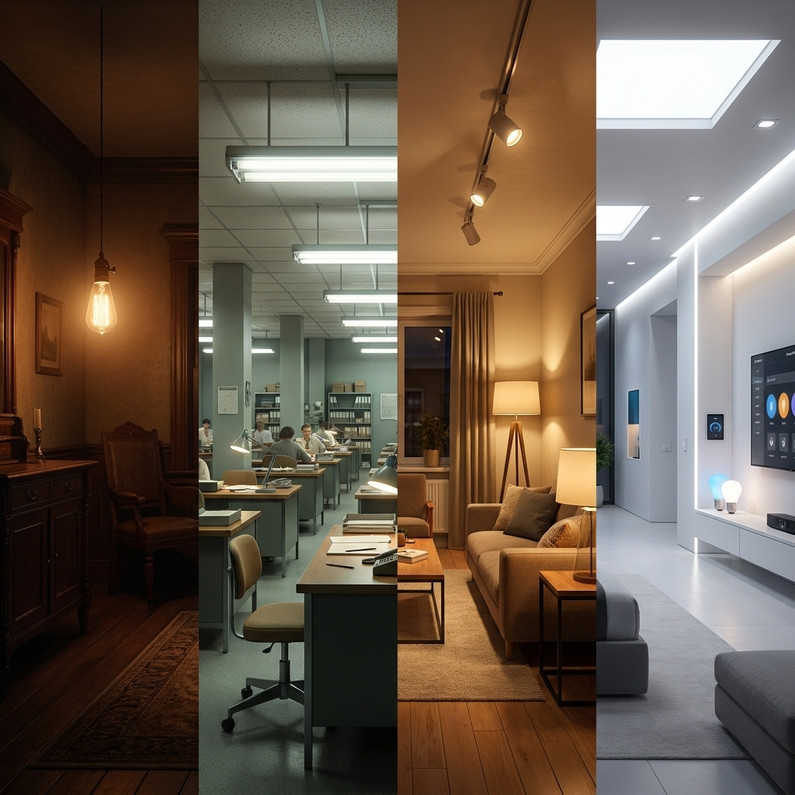
The Evolution of Lighting: Edison to LED Innovations
Imagine trying to read your favorite book, cook a meal, or navigate your home using only the faint, flickering glow of a candle. For most of human history, people relied entirely on fire to push back the darkness. Everything changed when inventors discovered how to harness electricity to create reliable, consistent light. The journey from the first glowing filaments to the highly advanced diodes we use now represents one of the most important technological leaps in human history.
This post explores the fascinating evolution of artificial lighting. You will learn how Thomas Edison’s famous invention transformed society, how fluorescent and halogen alternatives emerged to solve early efficiency problems, and why modern LED technology completely revolutionized how we illuminate our spaces.
The Dawn of Artificial Light: Thomas Edison and the Incandescent Bulb
When we think of the invention of the light bulb, we immediately picture Thomas Edison. While other inventors tinkered with early electric lights, Edison created the first commercially viable incandescent bulb in 1879. He achieved this by passing electricity through a carbonized bamboo filament inside a vacuum-sealed glass bulb.
This design prevented the filament from burning up too quickly, allowing the bulb to glow steadily for hundreds of hours. Suddenly, reliable light was available at the flip of a switch. Edison did not just invent a bulb; he built the electrical infrastructure needed to power it, including dynamos, wiring, and power stations.
How the Incandescent Bulb Changed Society
The incandescent bulb fundamentally altered human behavior. Before this invention, the setting sun dictated when work ended and when people went to sleep. With the arrival of electric light, factories could operate late into the night. People could socialize, read, and travel long after dark safely.
Streets became brighter and safer, reducing crime and extending the hours of commerce. The incandescent bulb became a symbol of human progress and innovation. However, these early bulbs had a significant flaw. They converted only about five percent of the electricity they used into actual light. The remaining ninety-five percent turned into wasted heat. As electricity demand grew, scientists realized they needed a more efficient solution.
The Mid-Century Shift: Fluorescent and Halogen Lighting
As the twentieth century progressed, researchers sought ways to create brighter light without wasting massive amounts of energy as heat. This drive for efficiency led to the development of two major alternatives: fluorescent and halogen lighting.
Fluorescent Lights Take Over Workspaces
In the 1930s, fluorescent lighting made its commercial debut. Instead of heating a solid filament, fluorescent tubes run an electrical current through mercury vapor gas. This current produces ultraviolet light, which then hits a phosphor coating on the inside of the tube, causing it to glow brightly.
Fluorescent lights lasted significantly longer than traditional incandescent bulbs and used far less energy. They quickly became the standard for offices, factories, and schools. They produced a bright, widespread illumination perfect for large spaces. However, people often complained about the harsh, cool color of the light. Many also found the subtle flickering and buzzing noises annoying, which kept fluorescent tubes from dominating the cozy living spaces of residential homes.
The Halogen Upgrade
To improve the residential lighting experience, scientists developed the halogen lamp in the 1950s. Halogen bulbs operate on the same basic principle as incandescent bulbs, using a heated tungsten filament. The difference lies in the halogen gas trapped inside the quartz bulb.
This gas creates a chemical reaction that redeposits evaporated tungsten back onto the filament. This clever recycling process extended the life of the bulb and allowed it to shine much brighter. Halogen lights produced a crisp, brilliant white light that accurately rendered colors, making them highly popular for retail displays, art galleries, and home accent lighting. While more efficient than standard incandescent bulbs, halogen lights still burned incredibly hot and consumed a considerable amount of electricity.
The LED Revolution: A Leap Forward in Technology
The next major breakthrough did not rely on heated filaments or glowing gases. Instead, it came from the world of solid-state electronics. In 1962, a scientist named Nick Holonyak Jr. invented the first visible-spectrum Light Emitting Diode (LED).
Early LEDs only produced red light and were incredibly dim. Manufacturers primarily used them as indicator lights on calculators, digital clocks, and control panels. It took decades of relentless research to develop LEDs capable of producing the bright, white light needed for general illumination. The crucial breakthrough occurred in the 1990s when scientists successfully created the blue LED, which eventually allowed engineers to produce white LED light.
What Makes LED Different?
LEDs generate light through electroluminescence. When you apply voltage to the semiconductor material inside the diode, electrons move and release energy in the form of photons. This process generates almost no heat.
Because they lack fragile glass enclosures and delicate filaments, LEDs are incredibly durable. They represent a complete departure from how we traditionally generated light. Instead of burning something to make it glow, LEDs use precise electronic processes to emit light directly.
Why LED Innovations Dominate the Modern Era
Today, LED technology dominates the lighting industry. Governments around the world actively phase out incandescent and halogen bulbs in favor of this superior alternative. The widespread adoption of LED lighting stems from three massive benefits: energy efficiency, incredible longevity, and environmental sustainability.
Unmatched Energy Efficiency
LEDs are exceptionally good at converting electricity into light rather than heat. A standard LED bulb uses up to ninety percent less energy than an equivalent incandescent bulb. This massive drop in energy consumption directly translates to lower utility bills for homeowners and businesses alike.
If you replace all the traditional bulbs in your house with LEDs, you will see an immediate reduction in your monthly energy costs. This efficiency also relieves significant stress on local power grids, reducing the need for new power plants.
Incredible Longevity
Nothing is more frustrating than dragging out a ladder to replace a burnt-out ceiling bulb. With traditional incandescent bulbs, you had to perform this chore every thousand hours of use. LEDs completely eliminate this frequent maintenance.
A high-quality LED bulb can last anywhere from 25,000 to 50,000 hours. If you leave an LED light on for five hours a day, it could theoretically last for over twenty years. This exceptional lifespan makes LEDs perfect for hard-to-reach fixtures, high ceilings, and outdoor security lighting.
A Win for Sustainability
The shift to LED technology represents a massive victory for the environment. Because they use so much less electricity, LEDs drastically reduce the greenhouse gas emissions associated with power generation.
Furthermore, unlike fluorescent tubes, LEDs contain no toxic mercury. This makes them completely safe to use in your home and much easier to dispose of or recycle when they finally stop working. The incredible lifespan of LED bulbs also means we manufacture, package, and ship far fewer replacement bulbs, significantly reducing the carbon footprint of the entire lighting industry.
Conclusion
We have come a long way from the glowing bamboo filaments of Thomas Edison's laboratory. The evolution from incandescent bulbs to fluorescent, halogen, and ultimately LED technology showcases our relentless pursuit of efficiency and innovation. Modern LED innovations provide unmatched light quality while drastically reducing our energy consumption and protecting the environment.
Take a walk through your home and evaluate your current lighting setup. If you still spot older incandescent or halogen bulbs, it may be time to upgrade to modern LED solutions. Brands like Cocoweb offer lighting that combines energy efficiency with long-lasting performance and refined design. By making the switch, you will lower your energy bills, reduce your environmental impact, and enjoy beautiful, reliable light for decades to come. Be sure to check the color temperature and lumen output on the packaging to find the perfect LED match for your specific room.
Recent Posts
-

How to Choose the Right Barn Light Finish for Your Home
Quick answer: The right barn light finish depends on three things: your home's exterior color temper …25th Sep 2026 -
6 Bathroom Lighting Setups for a Brighter Morning Routine
Quick answer: The best bathroom lighting setups for a brighter morning routine combine even, shadow- …3rd Sep 2026 -
How Far Apart Should Outdoor Post Lights Be? A Complete Spacing Guide
The right spacing between outdoor post lights can completely change the look and feel of your proper …4th Aug 2026