
How Pendant Lights Create Focal Points in a Room
Quick answer: Pendant lights create focal points by introducing shadow, visible fixture design, and a defined point of brightness that recessed lighting is built to avoid. While recessed cans spread even light across a ceiling, a pendant draws the eye downward to a single spot, giving a room a sense of intention and visual anchor.
Most ceilings today are lit the same way: a grid of recessed cans, evenly spaced, each one doing its small part to keep the room bright and shadow-free. It's an efficient system, and it's part of why so many kitchens and living rooms end up looking interchangeable. The lighting disappears into the architecture, which means it never does anything to define the space beneath it.
Pendant lights work differently. Instead of blending into the ceiling, a pendant hangs down into the room — visible, shaped, and finished in a way that recessed lighting was never designed to be. That visibility is exactly what gives it the power to create a focal point, something a flush ceiling fixture structurally can't do on its own.
This post looks at why pendant lighting succeeds at creating focal points where recessed lighting falls short, and how to think about where a pendant will have the most impact in a room.
Why doesn't recessed lighting create a focal point?
Recessed lighting is designed around a simple goal: illuminate a space evenly without drawing attention to the light source itself. Cans are spread across the ceiling at regular intervals so that no single spot is noticeably brighter than another. That uniformity is useful for general visibility, but it also means recessed lighting has no single feature for the eye to settle on.
Without a visible fixture or a concentrated pool of light, a room lit entirely by recessed cans tends to feel evenly lit but visually quiet. Nothing announces itself as the center of the space. The light does its job, but it doesn't contribute anything to how the room is perceived beyond basic brightness.
How does a pendant light draw the eye?
A pendant light is a visible object with its own shape, material, and finish, positioned at a height where it can actually be seen rather than tucked into the ceiling. That alone gives it an advantage recessed lighting doesn't have: it's something to look at, not just a source of illumination.
Pendants also concentrate light in a way recessed cans don't. Instead of spreading brightness evenly across a ceiling, a pendant creates a pool of light directly below it, with the surrounding area left comparatively dimmer. That contrast between bright and shadowed areas is part of what makes a pendant read as a focal point — the eye naturally moves toward the brightest, most defined area in a room.
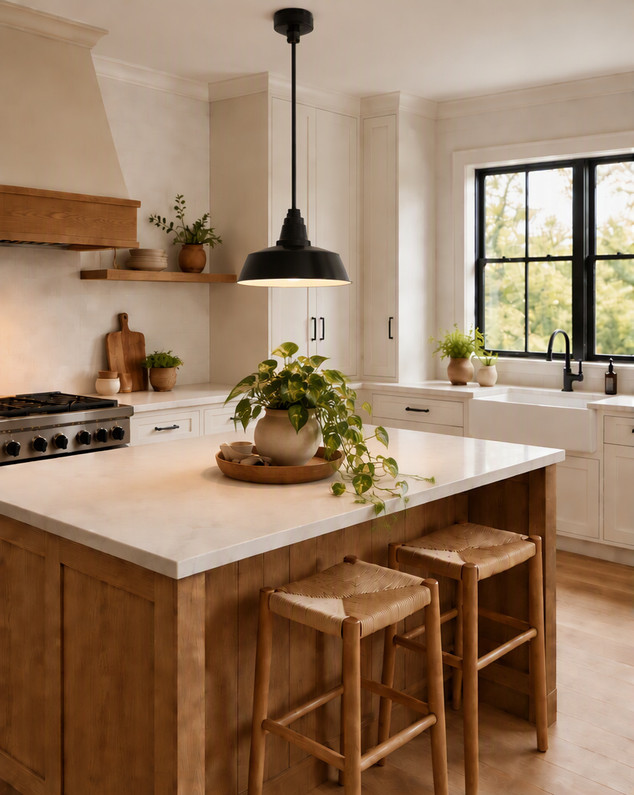
Over a kitchen island or dining table, this effect is easy to see in action. The pendant marks the space as the center of activity, even before anyone sits down.
Where in a room does a pendant light have the most impact?
Pendant lights tend to create the strongest focal points in spaces that already serve as a natural gathering point — areas where people already look or sit. A few common examples:
- Kitchen islands: The island is often the busiest surface in the kitchen, and a pendant hung above it reinforces that role visually.
- Dining tables: A pendant centered over a table signals where a meal happens before anyone pulls out a chair.
- Entryways: A single pendant near the front door gives visitors something to notice immediately upon entering.
- Reading nooks or small seating areas: In smaller spaces, a pendant can define the area without requiring additional furniture or architectural changes.
In each of these cases, the pendant isn't just adding light — it's confirming what the room already wants people to notice.
Does the style of the pendant matter for creating a focal point?
Yes, and matching the pendant's style to the rest of the room makes a real difference in how effective it is. A pendant with a distinctive shape or finish — a sculptural glass shade, an exposed-bulb fixture, or a metal design with visible detailing — stands out more and does more work as a focal point.
- Choose a bold or sculptural pendant if the surrounding space is relatively simple, with clean lines and few competing details. In that setting, the pendant has room to stand out without fighting other elements for attention.
- Choose a simpler, more understated pendant if the room already has strong visual elements — patterned tile, an accent wall, or detailed cabinetry. A quieter fixture complements the space instead of competing with it.
The goal either way is the same: the pendant should feel like a deliberate choice, not an afterthought.
Can pendant lighting and recessed lighting work together?
In most homes, yes. Recessed lighting still plays a practical role in keeping a room usable after dark, especially in larger spaces where a single pendant wouldn't provide enough overall brightness. The two aren't mutually exclusive — a well-planned room often uses recessed lighting for general illumination and a pendant for its focal point, letting each fixture do the job it's best suited for.
For smaller spaces like a breakfast nook or a reading corner, a single pendant may be enough on its own to handle both brightness and character, without needing supplemental recessed lighting at all.
Give the room something to look at
Even a well-lit room can feel underwhelming if there's nothing in it for the eye to land on. Pendant lighting fills that gap by doing what recessed lighting isn't designed to do: standing out, casting a defined pool of light, and giving a space a visual center.
The next step is simple — look at the room that feels the flattest, and consider where a single pendant could change how it reads. Often, the most effective fix isn't more light. It's a different kind of light, placed with intention. At Cocoweb, we design pendant lights and other fixtures with exactly that idea in mind — giving homeowners quality lighting options that do more than just brighten a room.
Frequently asked questions
Does a pendant light need to be centered in the room to work as a focal point?
No. A pendant is most effective when it's centered over the specific feature it's meant to highlight, such as an island or a table, rather than the room as a whole.
Can a pendant light replace recessed lighting entirely?
In smaller rooms, yes, especially if the pendant provides enough brightness for the space. Larger rooms generally benefit from keeping some recessed lighting for general visibility alongside the pendant.
How many pendant lights does a room need to create a focal point?
Often just one. A single, well-placed pendant is usually enough to anchor a space, though multiple pendants in a row are sometimes used over longer surfaces, like an extended kitchen island.
Does pendant lighting work in rooms with low ceilings?
Yes, as long as the pendant is sized and hung appropriately for the ceiling height. Smaller or flush-mounted pendant styles are often a better fit for rooms with limited vertical clearance.
Recent Posts
-
How Pendant Lights Create Focal Points in a Room
Quick answer: Pendant lights create focal points by introducing shadow, visible fixture design, and …23rd Oct 2026 -

How to Choose the Right Barn Light Finish for Your Home
Quick answer: The right barn light finish depends on three things: your home's exterior color temper …25th Sep 2026 -
6 Bathroom Lighting Setups for a Brighter Morning Routine
Quick answer: The best bathroom lighting setups for a brighter morning routine combine even, shadow- …3rd Sep 2026