
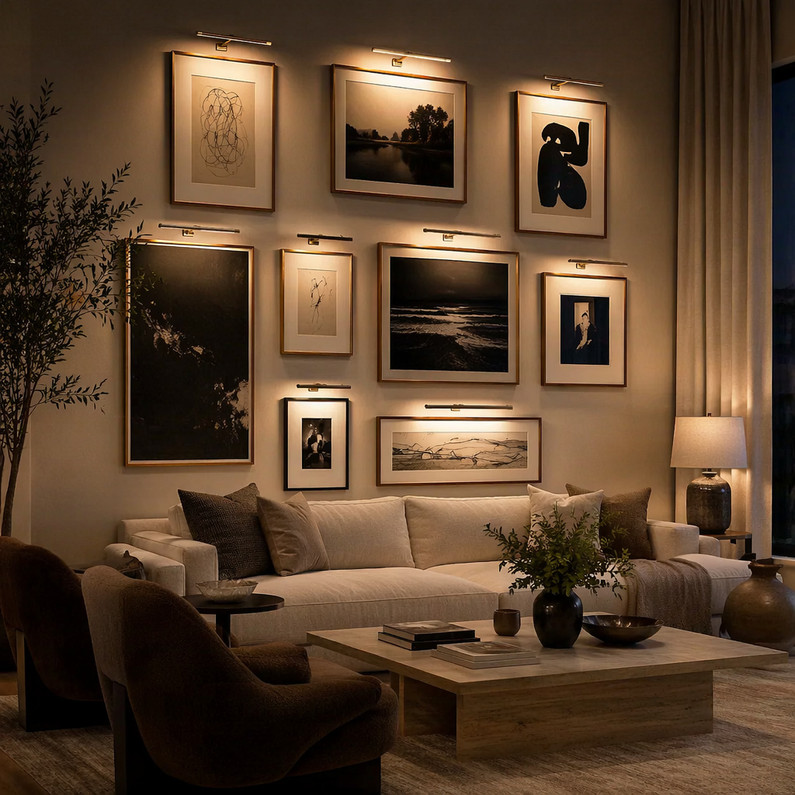
How to Light a Gallery Wall at Home
A gallery wall done well is one of the most impactful design moves you can make. A collection of framed artwork, photographs, and prints arranged across a single wall turns an ordinary room into something that feels curated, personal, and alive.
But here's what most people miss: the arrangement is only half the equation. The lighting is the other half — and it's the half that actually determines how the wall looks when people walk into the room.
Without intentional lighting, even a beautifully arranged gallery wall fades into the background. Pieces that should stand out become flat. Colors lose their richness. Textures disappear. The whole effect falls short of what it could be.
This guide gives you a practical, room-by-room framework for lighting a gallery wall at home — from choosing the right fixtures to getting the angles, color temperature, and layout exactly right.
What you'll learn:
- Why lighting matters more than the frames on a gallery wall
- The best lighting options for different gallery wall layouts
- How to coordinate fixtures across mixed frame sizes
- How to avoid glare, hot spots, and uneven illumination
- How to bring the look together in living rooms, hallways, staircases, and dining areas
What Is a Gallery Wall (and Why Does Lighting It Matter)?
A gallery wall is a curated grouping of artwork, framed photographs, prints, mirrors, or decorative objects arranged together on a single wall surface. Layouts range from tight, symmetrical grids to loose, salon-style arrangements with pieces of varying sizes and shapes.
The goal of a gallery wall is to create visual interest and tell a story — about the homeowner's taste, travels, relationships, or aesthetic. It's an inherently personal kind of decorating.
Lighting amplifies that story. The right light source brings texture, color, and depth to each individual piece while unifying the whole arrangement into something that feels intentional rather than accidental.
Without proper lighting, a gallery wall competes with the ambient light in the room — and usually loses. Pieces get washed out, ignored, or lost in shadow depending on where the overhead fixtures happen to land.
With proper lighting, the wall becomes the focal point. Every piece gets its moment.
Common Lighting Challenges for Gallery Walls
Lighting a single framed piece is relatively straightforward. A gallery wall introduces several complications worth planning for in advance.
Mixed Frame Sizes and Heights
Gallery walls rarely consist of identically sized frames. Mixing a large anchor piece with smaller surrounding works — each at different heights — makes it harder for a single light source to cover the whole arrangement evenly.
Inconsistent Illumination
A ceiling fixture positioned to highlight the center of the wall may leave corner pieces in shadow. Without a deliberate approach, you end up with a few well-lit pieces and several that disappear.
Glare on Glass
Multiple framed pieces under standard glass create multiple potential glare surfaces. With the wrong light angle, a viewer standing in the room sees reflections rather than artwork.
Cord Visibility on Plug-In Fixtures
Individual picture lights add visual complexity to a gallery wall. If plug-in cords aren't managed carefully, they become a distraction that undermines the arrangement's elegance.
Competing Color Temperatures
Using multiple light sources across a gallery wall — say, a ceiling fixture plus individual picture lights — can result in conflicting warm and cool tones that make the display look disjointed.
Each of these challenges has a solution. The key is choosing the right lighting approach for your specific layout.
The Best Ways to Light a Gallery Wall
There's no single right answer for gallery wall lighting. The best approach depends on the size of the arrangement, the room's architecture, and how much control you want over individual pieces.
Option 1: Individual Picture Lights for Each Piece
Mounting a dedicated picture light above each framed piece gives you maximum control over how every individual work is illuminated. Each fixture can be sized to match the piece beneath it, positioned for optimal coverage, and adjusted independently.
Best for: Smaller gallery walls with three to six pieces, arrangements with frames of similar depth and weight, and rooms where a high-end gallery aesthetic is the priority.
What to watch for: Multiple fixtures on a single wall can look cluttered if they're not well-coordinated. Keep finishes consistent and choose sizes proportional to each frame. For plug-in models, use cord covers or recessed cord channels to keep the installation clean.
This approach works beautifully with Cocoweb's LED picture lights, which are available in multiple sizes and finishes to coordinate across a mixed arrangement.
Option 2: Adjustable Track Lighting
Track lighting mounts to the ceiling and uses a series of adjustable heads that can be aimed at different points on the wall. A single track run can illuminate multiple pieces simultaneously, with each head targeted at a specific work.
Best for: Large gallery walls with many pieces, high-ceiling spaces, and arrangements where individual picture lights would be impractical or visually overwhelming.
What to watch for: Track lighting works best when the track is positioned 18 to 30 inches from the wall. Heads positioned too far back create a wide, shallow beam that barely skims the surface. Too close, and you get hot spots at the top of each piece with heavy shadow below.
Adjustable heads give you flexibility — but they require careful aiming during setup. Take the time to adjust each head individually rather than relying on default angles.
Option 3: Recessed Adjustable Spotlights
Recessed spotlights built into the ceiling offer the cleanest look — no visible fixtures, no cords, just light emerging from the ceiling and falling on the wall. Adjustable-gimbal recessed lights can be aimed at specific pieces.
Best for: Renovation projects, high-end interiors where ceiling fixtures are being specified from scratch, and gallery walls in rooms with lower ceilings where track lighting would feel intrusive.
What to watch for: Recessed spotlights are the least flexible option after installation. If you rearrange the gallery wall, the lights may not align with the new layout. Plan the arrangement before finalizing fixture placement.
Option 4: A Combination Approach
For large gallery walls with a mix of prominent anchor pieces and smaller surrounding works, combining approaches often gives the best result. Use individual picture lights on the largest, most important pieces — where close, focused illumination adds the most value — and supplement with track or recessed spotlights to wash the remaining pieces with more general accent light.
This gives you the precision where it matters most without overwhelming the wall with fixtures.
How to Handle Different Frame Sizes and Layouts
Gallery wall arrangements come in several common formats, each with its own lighting logic.
Grid Layouts
Symmetrical grid arrangements — equal-sized frames in rows and columns — are the most forgiving to light. Track lighting positioned to sweep evenly across the full grid works well. If using individual picture lights, consistent sizing across every frame keeps the look orderly.
Salon-Style Arrangements
Salon-style layouts mix sizes, orientations, and heights in an organic, art-world-inspired arrangement. These are more challenging to light evenly.
Start by identifying the anchor pieces — typically the largest works or those at eye level — and ensure those are lit first. Then work outward, filling in with supplemental light on the surrounding pieces. Adjustable track heads or carefully aimed recessed spots give you the flexibility to reach pieces at different heights and positions.
Horizontal Band Layouts
Some gallery walls use a horizontal band of frames at consistent height — a row of three to five pieces at eye level, for example. A short run of track lighting positioned above the arrangement, or a series of individual picture lights of matched size, works well here.
Staircase Arrangements
Staircase gallery walls follow the diagonal of the stairs, with frames arranged at ascending heights along the wall. These are among the most difficult to light evenly because no single ceiling fixture can easily cover the full diagonal range.
Individual picture lights — particularly rechargeable models that need no wiring — are often the most practical solution for staircase arrangements. They can be positioned exactly where needed without requiring an electrician.
Choosing the Right Color Temperature
Color temperature has a direct effect on how artwork looks under light. Getting it wrong means your carefully chosen pieces look flat, yellowed, or washed out.
Color temperature is measured in Kelvin (K):
- 2700K–3000K (warm white): Creates a cozy, gallery-like glow. Flatters oil paintings, watercolors, and warm-toned photography. Works well in living rooms and dining areas.
- 3500K–4000K (neutral white): Offers a clean, balanced light that works across a wider range of artwork styles. A good choice for contemporary or mixed-media gallery walls.
- 4000K–5000K (cool white): Best for black-and-white photography and high-contrast graphic work. Can feel clinical in residential settings unless the design is deliberately modern and cool-toned.
For most home gallery walls, 2700K to 3000K strikes the right balance — warm enough to feel residential, accurate enough to render colors well.
Coordinate Temperature Across All Fixtures
If you're using multiple light sources — individual picture lights plus ambient ceiling fixtures — make sure their color temperatures are compatible. A warm 2700K picture light next to a cool 4000K ceiling spotlight will make the artwork look inconsistent and the room feel disjointed.
Pick a color temperature and commit to it across the whole wall.
Don't Overlook CRI
Color Rendering Index (CRI) measures how accurately a light source renders color compared to natural daylight. For art lighting, look for a CRI of 90 or higher. Low-CRI light sources distort reds, mute blues, and flatten the tonal range of photography — exactly what you don't want on a gallery wall.
Cocoweb's LED picture lights are built with high-CRI output, which means your artwork is shown in its most accurate, vibrant form.
How to Avoid Glare on a Gallery Wall
Glare is one of the most common problems in gallery wall lighting — and one of the most avoidable.
Choose a narrow beam angle. Fixtures with a narrow beam (15–25 degrees) concentrate light on the artwork surface rather than scattering it broadly. Wider beam fixtures increase the chance of light bouncing back toward the viewer's eyes.
Mind the reflection angle. Light hitting glass at a certain angle will reflect back at the same angle in the opposite direction. Adjust fixture positioning so that angle doesn't land at the viewer's eye level from the room's primary seating or standing positions.
Consider anti-reflective glass. If you're framing new pieces, anti-reflective or museum-grade non-glare glass dramatically reduces the problem at the source.
Use matte or satin finishes where possible. Highly glossy surfaces — on frames, mats, or glass — amplify reflections. Matte frames and matte-surface prints are inherently more forgiving under directed light.
Gallery Wall Lighting by Room
Living Rooms
Living rooms are the most common location for gallery walls, and they typically offer the most lighting flexibility. Ceiling heights are standard, outlets are accessible, and the room usually has multiple light sources already in use.
Use a combination of picture lights on the most prominent pieces and supplemental ambient lighting to set the overall mood. Dimmer switches on picture lights allow you to adjust the intensity based on time of day and occasion — brighter for daytime and gatherings, softer for evenings.
Hallways
Hallways present a narrow, linear space that works well with a horizontal band of frames. Individual picture lights are often the cleanest solution here — they add light to a typically underlit space while highlighting the artwork at the same time.
For hallways without easily accessible outlets, rechargeable picture lights eliminate the need for any wiring and are particularly well-suited to rental properties.
Staircases
As mentioned above, staircase gallery walls are best served by individual fixtures on each piece. Rechargeable picture lights are practical, flexible, and avoid the cost and complexity of running new wiring along a stairwell wall.
Dining Areas
Dining areas often have warm, low-level lighting intended to create atmosphere. Gallery walls in these spaces benefit from warm-toned (2700K) picture lights that complement the room's existing mood rather than competing with it. Keep intensity moderate — the artwork should enhance the dining environment, not dominate it.
The Case for LED Art Lighting on a Gallery Wall
Whatever fixture approach you choose, LED should be the light source. Here's why it matters specifically for gallery walls.
Low heat output. Multiple light sources on a single wall can generate significant heat. Incandescent and halogen bulbs run hot enough to damage canvas, dry out paper, and accelerate color fading over time. LED bulbs run cool, making them safe for close, sustained illumination of artwork.
No UV radiation. UV light causes pigment fading and paper degradation — gradually but irreversibly. LED art lights emit negligible UV, protecting even delicate works over years of daily use.
Long lifespan. Premium LED fixtures last 25,000 to 50,000 hours. On a gallery wall with multiple fixtures, that longevity means you won't be cycling through replacements regularly — or risking damage to artwork while doing so.
Energy efficiency. Multiple fixtures running simultaneously add up quickly with traditional bulbs. LED fixtures use up to 80% less energy, keeping operating costs low without sacrificing light quality.
Dimming capability. Many LED art lights are dimmable, giving you the ability to fine-tune the ambiance of the entire gallery wall with a single adjustment.
Mistakes to Avoid When Lighting a Gallery Wall
Relying Solely on Overhead Ambient Lighting
Ceiling fixtures rarely illuminate a gallery wall evenly. They cast broad, undirected light that doesn't reveal texture, doesn't flatter color, and leaves corner pieces in shadow. Dedicated art lighting is always worth the investment.
Mismatching Color Temperatures Across Fixtures
Nothing disrupts a gallery wall more than inconsistent light. Warm and cool fixtures side by side make the wall look like a mistake rather than a design choice. Standardize your color temperature before you buy.
Using Oversized or Undersized Fixtures
A picture light that's too wide overwhelms a small frame. One that's too narrow leaves edges dark. Apply the half-to-two-thirds sizing rule: the fixture should span approximately 50–65% of the artwork's width.
Ignoring Cord Management on Plug-In Lights
Visible cords running down a gallery wall undermine the visual impact of the arrangement. Use cord covers, recessed cord channels, or paint-matched raceways to keep the installation looking clean and intentional.
Forgetting to Dim
A gallery wall lit at full intensity in a dimly lit dining room or cozy living room can feel harsh and out of place. Install dimmer switches or choose dimmable fixtures from the start. You'll use the flexibility constantly.
Bring Your Gallery Wall to Life
Lighting a gallery wall is not an afterthought — it's a design decision that shapes how every piece looks and how the whole arrangement feels in the room.
The right approach depends on your layout, your space, and how much individual control you want over each piece. Individual picture lights offer precision. Track lighting offers reach and flexibility. A combination of both often delivers the best of both worlds.
Whatever approach you choose, prioritize LED fixtures with high CRI, the right color temperature for your room, and finishes that coordinate across the arrangement. The difference between a gallery wall that merely exists and one that genuinely commands attention is almost always the light.
Cocoweb's picture light collection offers LED fixtures in multiple sizes, finishes, and mount types — including plug-in, hardwired, direct wire, and rechargeable options — designed to work individually or as part of a coordinated gallery wall installation. Explore the full range at Cocoweb and find the fixtures that fit your wall, your frames, and your style.
Recent Posts
-
How Pendant Lights Create Focal Points in a Room
Quick answer: Pendant lights create focal points by introducing shadow, visible fixture design, and …23rd Oct 2026 -

How to Choose the Right Barn Light Finish for Your Home
Quick answer: The right barn light finish depends on three things: your home's exterior color temper …25th Sep 2026 -
6 Bathroom Lighting Setups for a Brighter Morning Routine
Quick answer: The best bathroom lighting setups for a brighter morning routine combine even, shadow- …3rd Sep 2026